
EMI Loading
Yamaha FZ Blue Flex Variants & Prices
| Variant Details | Ex. Showroom Price | |
|---|---|---|
FZ Blue Flex149 cc | 11.7 PS | 12.8 Nm @ 6000 rpm | ₹ 1.25 Lakh* |
FZ Blue Flex
Yamaha FZ Blue Flex Overview

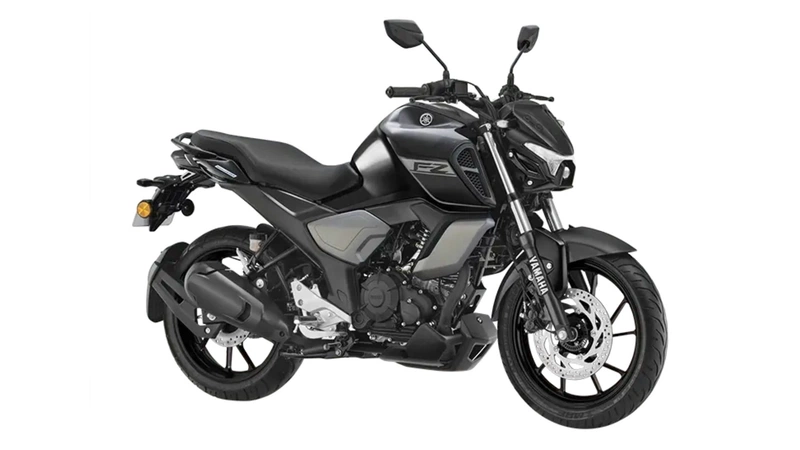
The Yamaha FZ Blue Flex is the brand's first flex-fuel motorcycle in India, and it stands as the sole 150cc bike in the country capable of running on ethanol blends ranging from E20 to E85. It is built on the same platform as the FZ Rave, sharing its street-naked silhouette, LED lighting setup, sculpted fuel tank, and compact exhaust.
Under that familiar skin, the 149cc air-cooled, fuel-injected engine has been recalibrated for the new fuel, dropping peak output slightly to 11.7 PS and 12.8 Nm compared to the standard Rave.
The 5-speed gearbox, telescopic fork, rear monoshock, disc brakes at both ends, and single-channel ABS all carry over unchanged.
Further, the instrument cluster is fully digital, covering speed, tachometer, fuel level, and clock, with Yamaha's Y-Connect app support for phone notifications.
Lastly, it is available in a single Metallic Black colour.
Engine, Performance and Mileage
Engine, Performance and Mileage
The FZ Blue Flex runs a 149cc, air-cooled, single-cylinder engine, the same core unit that powers the rest of the FZ lineup, but internally reworked to accept ethanol blends from E20 to E85. The engine drives a constant-mesh 5-speed gearbox with a wet multi-disc clutch.
The recalibration results in a slight dip in output from the standard FZ Rave: down to 11.7 PS and 12.8 Nm. This is a known consequence of ethanol's lower energy density.
As for mileage, no certified figure has been published specifically for the Blue Flex at the time of writing.
design
design
The FZ Blue Flex is visually identical to the FZ Rave, where the front features a full-LED projector headlamp with integrated position lamps, flanked by a sharp, angular fairing that gives the face a purposeful look without going overboard.
The fuel tank carries on the FZ's signature muscular sculpting, with tank extensions featuring faux air vents on either side. It is a design that has been around for a while in the FZ family, but it still holds up, showcasing clean lines, no clutter, nothing excessive.
The side profile is tidy with a slim tail section and a single-piece seat that keeps the rear uncluttered.
At the rear, the exhaust is compact and tucked in neatly, while the underbelly sits at 135 mm of ground clearance, notably lower than the 165 mm on the FZ Rave, which is one physical change you will notice if you look closely.
Lastly, both 17-inch alloy wheels are shod with tubeless rubber: a 100/80 section up front and a wider 140/60R at the rear.
safety
safety
Braking on the FZ Blue Flex is handled by a 282 mm disc at the front and a 220 mm disc at the rear, with single-channel ABS as standard across the board. Single-channel ABS, as opposed to dual-channel, only intervenes at the front wheel during hard braking, the rear remains unassisted.
The telescopic front fork with a 41 mm inner tube diameter and a rear monoshock provide the suspension underpinning, tuned to handle urban road conditions. Additionally, the tubeless tyre setup at both ends reduces the risk of sudden deflation in the event of a puncture.
competition
competition
The FZ Blue Flex currently has no direct flex-fuel rival in the 150cc segment, but it competes day-to-day against similarly priced 150-165cc street bikes like the Honda SP160, Bajaj Pulsar N160, and Hero Xtreme 160R.
On paper, both the SP160 (13.46 PS) and the Xtreme 160R (15.22 PS) offer stronger performance while undercutting the FZ on price. Meanwhile, the performance-forward Pulsar N160 dominates the spec sheet with 16 PS, a massive 14-litre tank, and premium hardware like dual-channel ABS and USD forks.
Even on the tech front, rivals are pulling ahead. The Honda’s top variant, for instance, boasts a 4.2-inch TFT display with RoadSync support that the Yamaha cannot match.
However, none of these rivals can run on E85, making the Yamaha a meaningful differentiator as India's ethanol infrastructure expands. It is also agile at just 139 kg, being a full 15 kg lighter than the Pulsar N160, that should give it better manoeuvrability.